Homeschooling while working full-time sounds a little unrealistic at first.
Most people picture a parent sitting at the kitchen table all day, guiding every lesson, answering every question, and somehow still managing a full-time job on top of it. That model doesn’t just feel overwhelming, it is not sustainable.
But here’s the thing: that version of homeschooling isn’t the only option.
In fact, it might not even be the best one.
We’ve all been conditioned to believe that learning takes 6–8 hours a day because that’s what traditional school looks like. But that structure was built for classrooms, not homes.
What actually matters isn’t how long your child is sitting at a desk—it’s how effectively they’re learning.
Research (like what’s highlighted in your blueprint) shows something surprising: kids don’t need marathon school days to succeed. They often do better with shorter, focused learning time.
So instead of asking,
“Do I have 8 hours to homeschool?”
a better question is:
“How can I make 2–4 hours actually count to meet my state’s requirements and my child’s needs?”
That shift changes everything.
Once you let go of the “school day” mindset, homeschooling becomes a lot more doable.
You’re no longer trying to recreate school at home.
You’re building something better.
Think of it like this:
Traditional school = time-based (“Did we sit long enough?”)
Effective homeschooling = outcome-based (“Did we actually learn and meet the minimum requirements?”)
And when you focus on outcomes, you can cut out a lot of wasted time.
Kids don’t need hours of repetition, waiting, transitions, and busywork. They need:
That’s where the 2–4 hour model comes in, and why the rest of your time can be field trips, interactive lessons, or project-based learning like this:https://outschool.com/classes/project-based-middle-school-math-class-pHNjdRty?usid=h2M5RTxl&signup=true&utm_medium=referral&utm_campaign=educator_share_activity_link
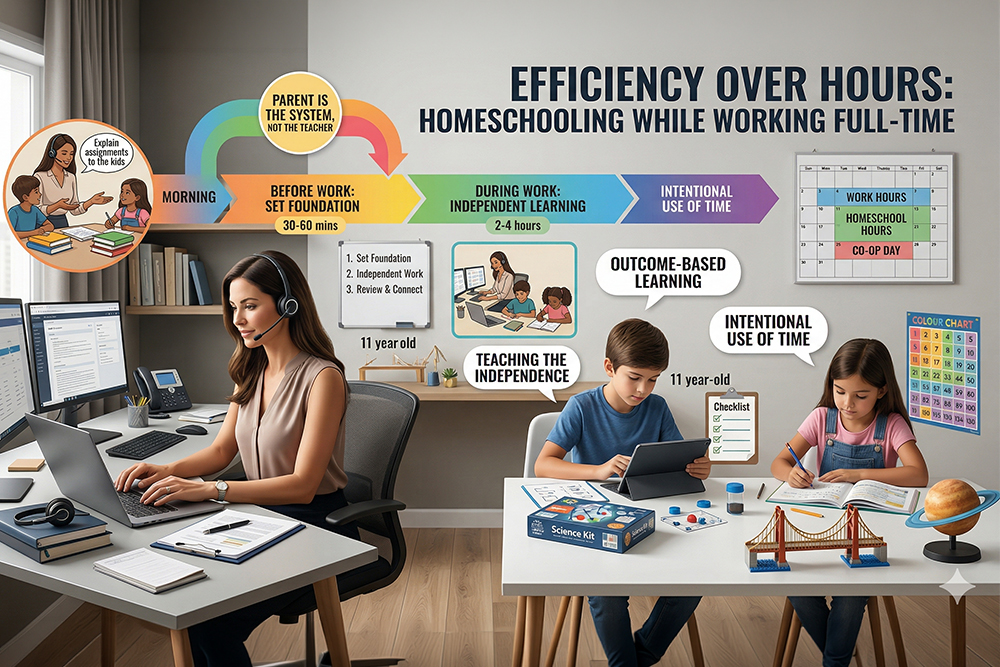
Instead of trying to do everything at once, break your day into three manageable parts.
This is your most hands-on time.
You’re not teaching all day—you’re just setting things up:
Once your child knows what to do, they’re ready to run with it.
This is where the magic happens—and where many parents get stuck.
The key is shifting your child from needing constant help to working more independently.
That doesn’t happen overnight. It’s built gradually.
Start small:
Over time, your child learns how to manage their work without needing you every five minutes.
And while they’re working, you’re… working.
No guilt. No juggling both at the same time.
This doesn’t need to be long.
Just:
This is also a great time for the kind of learning that doesn’t fit into worksheets—discussions, projects, hands-on stuff.
It’s less about “school” and more about connection.
One of the biggest mindset shifts is realizing your child doesn’t need to rely on you for everything.
In fact, the goal is the opposite.
Start with:
Short bursts of independent work
Then move to checklists instead of verbal instructions
Eventually, your child begins self-monitoring
At that point, something really powerful happens:
They stop waiting to be told what to do—and start taking ownership.
That’s not just helpful for homeschooling. That’s a life skill.
Let’s talk about the obvious question:
“What happens while I’m working?”
You don’t have to do this alone.
There are two types of support that make a huge difference:
Look for programs that:
This reduces how much you have to manage manually.
Sometimes the best solution isn’t digital.
Think:
Even one consistent backup option can take a huge amount of pressure off.
This might be the most important idea of all.
You don’t have to be:
Instead, your role becomes:
You’re not running the class.
You’re running the system.
Homeschooling as a working parent isn’t about doing more.
It’s about doing things differently.
When you:
…it stops feeling impossible.
And starts feeling sustainable.
You don’t need to be available all day.
You just need to be intentional with the time you do have.
 844-977-0040